Because Aloe Vera is so great to have on hand and can be used for so many ways, I wanted a way to preserve it. By drying it and turning it into a powder, I can use it in a variety of ways and store it for long time usage. Also, dehydrated Aloe Vera powder is believed to boast the highest concentration of the nutrients present in the plant.


Aloe Vera is a tremendously useful plant. The juice inside of the Aloe Vera plant is great for easing the pain from burns; soothes bug bites and it makes a great moisturizer. It might sound weird but Aloe Vera is also considered to be a super food. It contains amino acids, minerals (calcium, iron, magnesium and potassium), vitamins (A, C, E, B1, B2, B6, and B12), fatty acids, and enzymes. It is also high in fiber.
When dehydrating the Aloe Vera plant, keep in mind that it takes a LONG time to dry (2-3 days) but it is super easy to do. If you don't grow your own Aloe Vera, you can generally pick up a giant leaf at your local grocery store. I purchased the above leaf (almost 3 feet long) for just 69 cents at our local grocer. They can generally be found in the produce section.
The first step is to wash the leaf thoroughly. Next, you will need to peel off the outer layers (the rind) of each leaf. The rind is thick and green. I use a paring knife for this part.


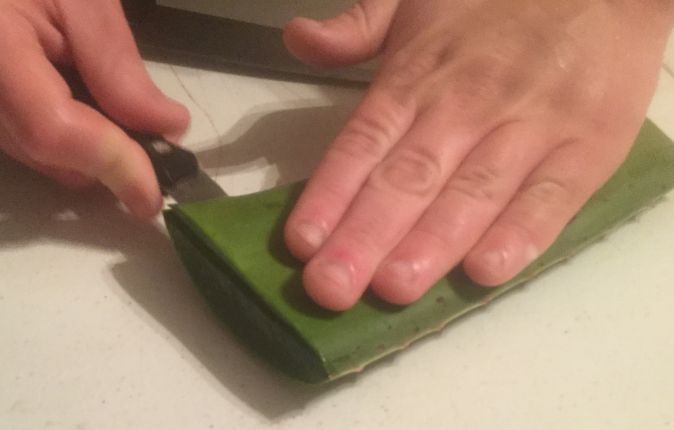


Once you have the outer layer off, wash it thoroughly. The yellow juice from the rind has a laxative effect and can also deplete your body of potassium so just be sure to wash and rewash the leaf before continuing.
Once you have it rinsed, cut this outer layer into manageable sized pieces that are all about the same size (so they dry evenly) and place the pieces onto your dehydrator trays. Be sure to place them on the tray slimy side up.
Next, cut up or scoop up the pulpy part of the Aloe Vera leaf and place them pulp side up on your dehydrator trays.


Turn on your dehydrator to 135 degrees. It will probably take the rind about 12 hours to dry but the pulpy part can take 48-56 hours to completely dry. You know the pulp is ready when it turns to a crumbly white powder or will be super dry and brittle, depending on how thick you put the aloe on the trays.


Turn on your dehydrator to 135 degrees. It will probably take the rind about 12 hours to dry but the pulpy part can take 48-56 hours to completely dry. You know the pulp is ready when it turns to a crumbly white powder or will be super dry and brittle, depending on how thick you put the aloe on the trays.

Once all pieces are completely dry, put them into a blender or a food processor and pulse them until they turn into a fine powder. Store them in vacuum sealed bags or in sealed mason jars.
To use, just rehydrate the powder by adding 1 teaspoon of water to each 3 tablespoons of powder. Place the water and powder into a small, shallow bowl and stir; allow to sit for 5-7 minutes, until it turns to gel form.
If you are wanting to use the powder in food or beverages, then don't rehydrate, just add a teaspoon or more directly into the food/drink and stir well. It can also be added in powder form into a smoothie or juice for body cleansing purposes.
Our family uses the reconstituted gel as a toothpaste. It does a great job and is a great option if you have sensitive teeth like I do. It also reduces inflammation in my gums.
****NOTE****
Pregnant women and children under the age of 18 should not eat/drink Aloe Vera. Pregnant women should avoid it during pregnancy because it can increase the risk of contractions and also because Aloe Vera can lower blood glucose levels (the same reason children should not use it either). My hubby and I are both diabetic and use Aloe Vera to lower our blood glucose levels. It does seem to help.
****NOTE****
Pregnant women and children under the age of 18 should not eat/drink Aloe Vera. Pregnant women should avoid it during pregnancy because it can increase the risk of contractions and also because Aloe Vera can lower blood glucose levels (the same reason children should not use it either). My hubby and I are both diabetic and use Aloe Vera to lower our blood glucose levels. It does seem to help.
I shared this blog post with the following blogs and link parties:
Happiness is Homemade Link Party
Marilyn's Treats
The Dishing It, Digging It Link Party
Wonderful Wednesday 261
Wise Woman Linkup
Meal Plan Monday
Our Home Away from Home
Back to the Basics
The Inquisitive Farmwife
Miz Helen's Country Cottage
Life as we know it by Paula
The Charm of Home
Claire Justine
Share it One More Time
April J Harris
Julie's Creative Lifestyle
Create with Joy
Confessions of a Plate Addict
Tickle My Taste Buds
A Stroll Thru Life
JENerally Informed
Homemaking Linkup
Homestead Blog Hop
Simple Homestead Blog hop
Sincerely Paula
Strawberry Butterscotch
Our Mini Family
Smell Good Sunday
Mix it Up Monday Link Party
Meet up Monday Link Party
Over the Moon Link Party
A Pinch of Joy
Marilyn's Treats
The Dishing It, Digging It Link Party
Wonderful Wednesday 261
Wise Woman Linkup
Meal Plan Monday
Our Home Away from Home
Back to the Basics
The Inquisitive Farmwife
Miz Helen's Country Cottage
Life as we know it by Paula
The Charm of Home
Claire Justine
Share it One More Time
April J Harris
Julie's Creative Lifestyle
Create with Joy
Confessions of a Plate Addict
Tickle My Taste Buds
A Stroll Thru Life
JENerally Informed
Homemaking Linkup
Homestead Blog Hop
Simple Homestead Blog hop
Sincerely Paula
Strawberry Butterscotch
Our Mini Family
Smell Good Sunday
Mix it Up Monday Link Party
Meet up Monday Link Party
Over the Moon Link Party
A Pinch of Joy


